
September 19, 2026
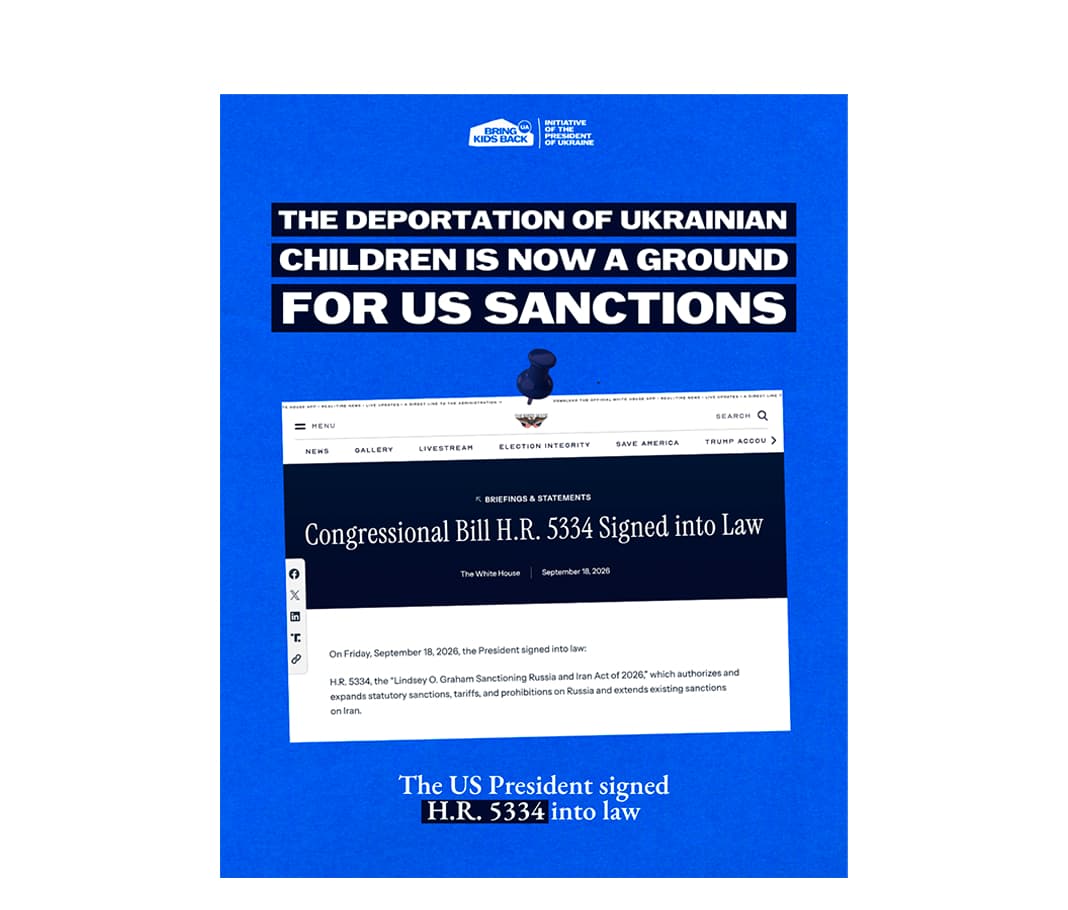
The U.S. President has signed a law making the deportation of Ukrainian children grounds for sanctions.
Those who may face restrictions include not only those who transported the children, but also officials, institutions, and intermediaries who organized or facilitated these actions. The sanctions involve the freezing of assets in the United States and a ban on entry into the country.
Kyiv, September 19, 2026. On September 18, the U.S. President signed H.R. 5334, the Lindsey O. Graham Sanctioning Russia and Iran Act of 2026. Among the grounds for imposing sanctions, the law explicitly identifies the forced transfer and forcible deportation of children as serious human rights violations against Ukrainian nationals.
The bill was introduced in Congress under this number in September 2025, and the sanctions provisions were added in the summer of 2026. The law introduces and expands sanctions mechanisms targeting Russia — including its officials, financial and energy sectors, and those helping it evade restrictions — and extends the Iran Sanctions Act of 1996 through 2031.
Who may face sanctions for crimes against children. The law refers to foreign persons, which includes both individuals and organizations: institutions, foundations, guardianship bodies, transportation providers, and any legal entities that are not American. The law separately lists senior officials of the Russian Federation who are subject to restrictions by virtue of their positions and authorizes the U.S. President to add other senior officials to this list.
What actions may trigger sanctions. The grounds include knowingly participating, directly or indirectly, in serious human rights violations against Ukrainian nationals. The law identifies forced transfers, enforced disappearances, unlawful detention, the forcible deportation of children, and torture among these violations. This list is not exhaustive. The reference to indirect participation extends the provision to intermediaries and those who facilitated the execution of these actions, not just their direct perpetrators. The law also defines what constitutes acting “knowingly”: it is sufficient that a person should have known about their actions and their consequences; proof of direct intent is not required.
What the sanctions mean in practice. There are two types of restrictions. The first is a full asset freeze: all property and interests in property held in the United States or under the control of U.S. persons are frozen, and any transactions involving them are prohibited. The second involves visa restrictions: the person becomes ineligible to enter the United States or receive any immigration benefits, and any existing visas are revoked immediately. Violations of these prohibitions carry civil and criminal liability under U.S. law. The U.S. President decides which individuals and organizations are added to the sanctions lists.
“The deportation of children now carries a price enshrined in U.S. law, not just in political statements,” says Maksym Maksymov, Head of Bring Kids Back UA. “The provision on indirect involvement means that it applies not only to those who physically transported a child, but also to those who processed the paperwork and financed these actions: guardianship bodies, transportation providers, and officials who signed the documents. This provision is part of the same law that imposes sanctions on Russia’s oil, banking, and defense industries. This means that the deportation of children is no longer a separate humanitarian track in negotiations, but a full-fledged instrument of pressure on the aggressor. It is this same pressure that ultimately brings both the end of the war and the return of children closer.”
The key distinction of this decision lies in its legal status. The grounds for imposing sanctions over the deportation of Ukrainian children are now enshrined in law rather than an executive order, meaning they cannot be repealed simply by changing an administrative decision. At the same time, the law does not automatically add anyone to the sanctions lists: it establishes a mechanism, while the implementation of that mechanism will depend on specific decisions by the U.S. administration.