
November 16, 2026
Key Events of October 2026
In October 2026, Ukraine continued its efforts to bring back children illegally deported or forcibly transferred by Russia, as well as those remaining in temporarily occupied territories. At the same time, international cooperation, sanctions pressure, accountability efforts, reintegration support and international advocacy were further strengthened.
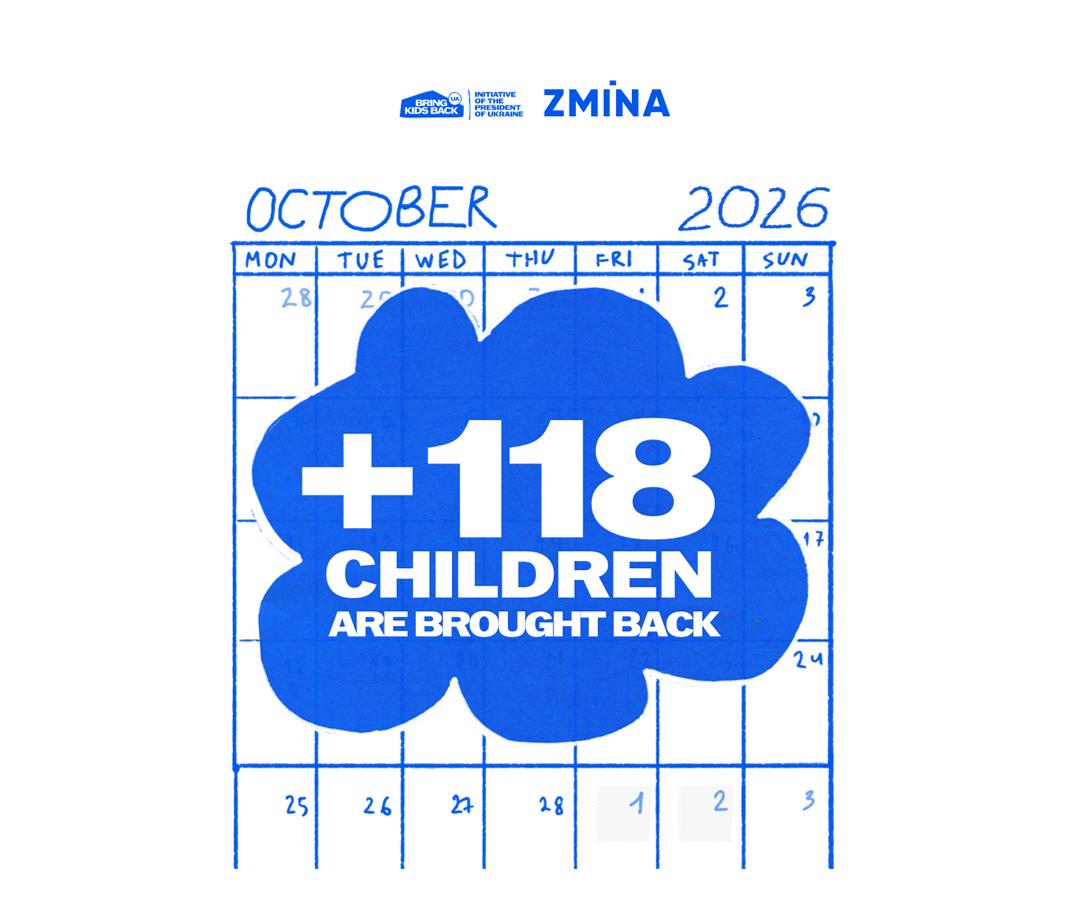
A total of 118 children were returned during the month, bringing the overall number of returned children to 2,775.
Key developments in October 2026:
The United Kingdom announced an additional £3 million in funding for the 2027–2028 financial year to support the search for Ukrainian children, their safe return and reintegration. This will bring the total amount of UK assistance in this area to £7 million.
The United Kingdom also introduced a new sanctions package comprising 31 measures against Russia, including restrictions targeting seven individuals involved in the indoctrination and militarisation of Ukrainian children. The British Government highlighted the systematic transfer of children to so-called “re-education” camps and the use of propaganda and military programmes to erase their Ukrainian identity.
On 7 October, Bring Kids Back UA Head Maksym Maksymov addressed the Ukraine Parliamentary Support Group at the OSCE Parliamentary Assembly in Andorra. He presented data on Russian state funding for the system of indoctrination and militarisation of children: in 2026, Russia allocated approximately €237 million to the Movement of the First and €13 million to Yunarmiya. Participants discussed the need to strengthen international pressure and ensure accountability for these crimes.
At the same OSCE Parliamentary Assembly meeting, young Ukrainians who had experienced occupation shared their testimonies of forced Russification, persecution for their Ukrainian identity and the militarisation of school education. They spoke about threats, coercion to obtain Russian documents and military training imposed on children. Their stories demonstrated how Russia systematically restricts the rights and freedoms of Ukrainian young people in the occupied territories.
On 13 and 15 October, Members of the Ukrainian Parliament and Bring Kids Back UA held expert meetings on improving support for returned children and coordinating sanctions policy. Participants discussed establishing a unified support standard, including access to housing, document restoration, education and medical care. Deputy Speaker of the Verkhovna Rada Olena Kondratiuk emphasised that only 5% of individuals sanctioned for crimes against children appear on the sanctions lists of all seven jurisdictions, while 42% of individuals on Ukraine’s sanctions list are absent from the lists of international partners.
Bring Kids Back UA, together with the Coordination Centre for the Development of Family-Based Care and Child Care, held consultations with young people aged 18–23 who had returned from deportation or temporarily occupied territories. Participants identified their main needs in five areas: housing, education, employment, psychological support and obtaining documents. The findings will help shape reintegration policies and the work of a youth advisory group based on the principle of “Nothing about young people without young people.”
On 8 October, at the Donbas Media Forum in Kyiv, Bring Kids Back UA Policy Lead Oleksandra Dvoretska emphasised the importance of regional media, journalists, community leaders and personal contacts in reaching families who remain under occupation. Due to the blocking of Ukrainian resources and Russia’s information isolation, many families may be unaware of opportunities for safe departure, document restoration and support after returning.
On 15–16 October, the European Council called on Russia and Belarus to ensure the immediate, safe and unconditional return of all Ukrainian children and other civilians who had been illegally deported or forcibly transferred. European leaders reaffirmed that the return of Ukrainian children must remain an integral part of the path towards a just and lasting peace.
On 22 October, Ukrainian law enforcement authorities notified Russian-appointed occupation official Volodymyr Saldo and two other individuals of suspicion in a case involving the forcible transfer of three Ukrainian schoolchildren from the Kherson region to occupied Crimea in 2022. According to the investigation, the children were taken without their parents’ consent under the pretext of providing “health rehabilitation” and were later involved in military-patriotic activities. In 2023, the children returned home as part of the Bring Kids Back UA initiative, with the assistance of Save Ukraine.
On 8–9 October, Thórdís Kolbrún Reykfjörð Gylfadóttir, the Council of Europe Special Envoy on the situation of children of Ukraine, visited Kyiv. During meetings with Ukrainian officials, including Bring Kids Back UA Head Maksym Maksymov, she discussed the return of children, rehabilitation, reintegration and the development of family-based care. The Special Envoy reaffirmed the Council of Europe’s support for Ukrainian institutions, children and their families.
In October, the upcoming release of the documentary Ash and Crayons, directed by Evgeny Afineevsky, was also announced. The film tells the stories of seven children whose lives were changed by Russia’s full-scale war against Ukraine, including children who were returned after being abducted and those released from captivity. The US premiere is scheduled for 20 November, with the Ukrainian premiere set for 3 December 2026. The Ukrainian World Congress, Bring Kids Back UA and War Child International joined the film’s communications campaign.
Hundreds of thousands of Ukrainian children remain under Russian control.
There can be no just and lasting peace without the return of Ukrainian children.