
November 9, 2026
How to Prove the Militarization and Indoctrination of Ukrainian Children Abducted by Russia: Government, Civil Society and International Partners Join Forces
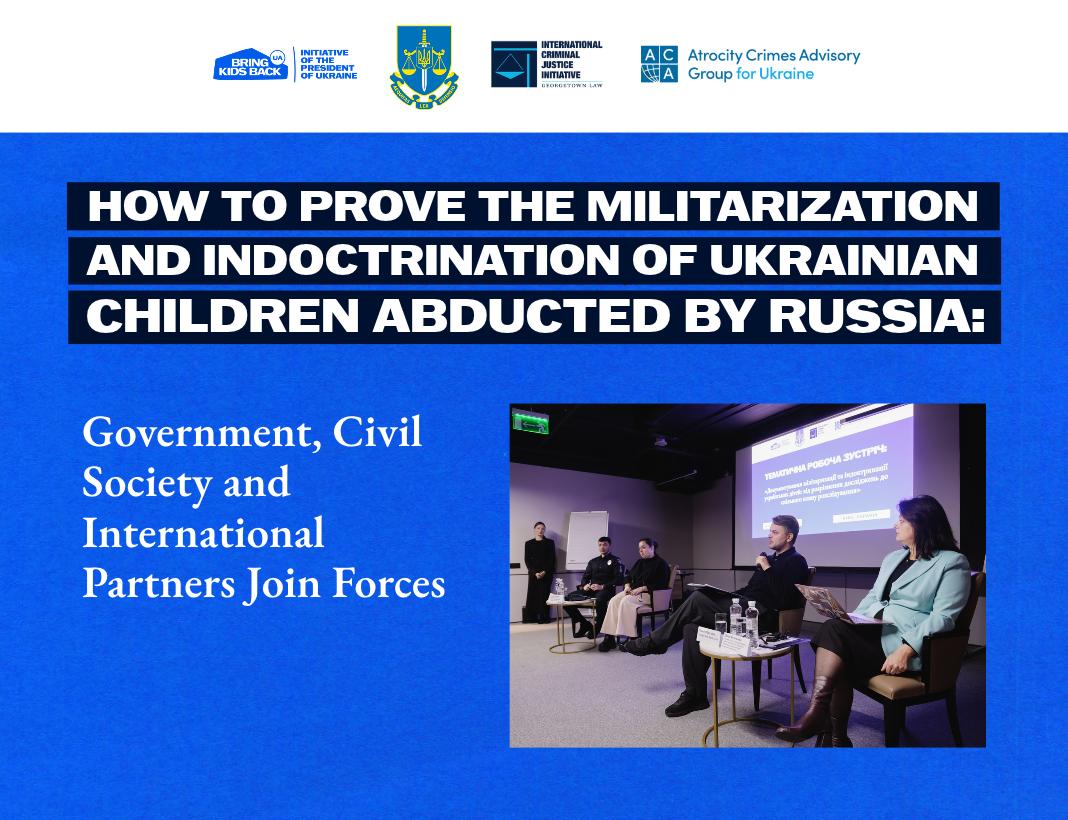
On November 6, the President of Ukraine’s Bring Kids Back UA initiative, together with the Office of the Prosecutor General of Ukraine and in partnership with the International Criminal Justice Initiative (ICJI) at Georgetown University Law Center, held a thematic working meeting, “Documenting the Militarization and Indoctrination of Ukrainian Children: From Fragmented Research to a Joint Investigation Plan.”
The meeting brought together representatives of law enforcement agencies, civil society organizations, documenters and international experts. Its goal was to build a coordinated documentation system on the basis of individual studies. This is how Russia’s crimes against Ukrainian children can be proven in court.
Participants included Daria Herasymchuk, Adviser to the President of Ukraine – Presidential Commissioner for Children’s Rights and Child Rehabilitation; Olesia Voloshyna, Deputy Head of the Department for the Protection of Children’s Interests and Combating Domestic Violence at the Office of the Prosecutor General of Ukraine; and Serhii Panteleiev, First Deputy Head of the Main Investigative Department of the National Police of Ukraine.
“I am convinced that the militarization and indoctrination of children must become a separate, seventh grave violation under the UN’s Children and Armed Conflict (CAAC) mechanism. Alternatively, the approach to violations of the right to education during armed conflict must be fundamentally reconsidered. Our common goal is not just to collect testimony, but to protect children, preserve their mental health and give them a chance at a happy future,” said Daria Herasymchuk, Adviser to the President of Ukraine – Presidential Commissioner for Children’s Rights and Child Rehabilitation.
What Needs to Be Proven and What Evidence Is Missing: The Georgetown Report
Participants were presented with a report by the International Criminal Justice Initiative at Georgetown University Law Center, “Indoctrination and Militarization of Ukrainian Children by the Russian Federation: An International Law Analysis,” prepared at the request of Bring Kids Back UA. The report provides a legal framework for classifying the practices Russia applies to Ukrainian children in the temporarily occupied territories and after deportation.
According to the report, around 1.6 million children in the temporarily occupied territories are subjected to Russian-directed indoctrination and militarization. At least 582,600 of them are of school age. The authors concluded that this campaign violates international humanitarian law and international human rights law.
The ICJI report clearly identifies which elements of the crimes must be proven, and which evidence is still missing, for these acts to be properly assessed by national and international courts. Participants worked in working groups on how to close these gaps.
From Mapping Practices to a Documentation Plan
A separate session was devoted to mapping practices of militarization and indoctrination, from “patriotic education” and military camps to the involvement of children in militarized movements. Participants also discussed the key findings of the 2026 OSCE Moscow Mechanism report and their significance for further documentation.
A representative of the Office of the Prosecutor General presented practical tools that help civil society organizations collect information in a way that allows it to serve as evidence in criminal proceedings.
“Information collected by civil society organizations can serve as full-fledged evidence in criminal proceedings — provided it is properly recorded. That is why, together with our partners, we are developing common approaches to documentation. Every properly documented case of a child’s militarization brings us closer to a verdict against those responsible,” said Olesia Voloshyna, Deputy Head of the Department for the Protection of Children’s Interests and Combating Domestic Violence at the Office of the Prosecutor General of Ukraine.
In the working groups, participants identified priority practices for documentation and outlined the areas of a joint plan:
searching for physical evidence;
recording digital evidence;
collecting testimony;
identifying the structures involved and their sources of funding.
Maksym Maksymov, Head of Bring Kids Back UA:
“The Russian authorities are turning Ukrainian children into a resource for their war. Under the guise of ‘patriotic education,’ Russia is militarizing children it has abducted or holds in the temporarily occupied territories. This is a crime, and Russia will be held accountable for it. To make sure no one involved escapes justice, every such practice must be properly documented.”
What’s Next?
The working groups’ output will form the basis of a joint plan for documenting the militarization and indoctrination of Ukrainian children. Bring Kids Back UA and the Office of the Prosecutor General will continue to coordinate work with civil society organizations and international partners.