
November 19, 2026
Bring Kids Back UA Holds Media Briefing on the Return and Support of Children Abducted by Russia Ahead of World Children’s Day
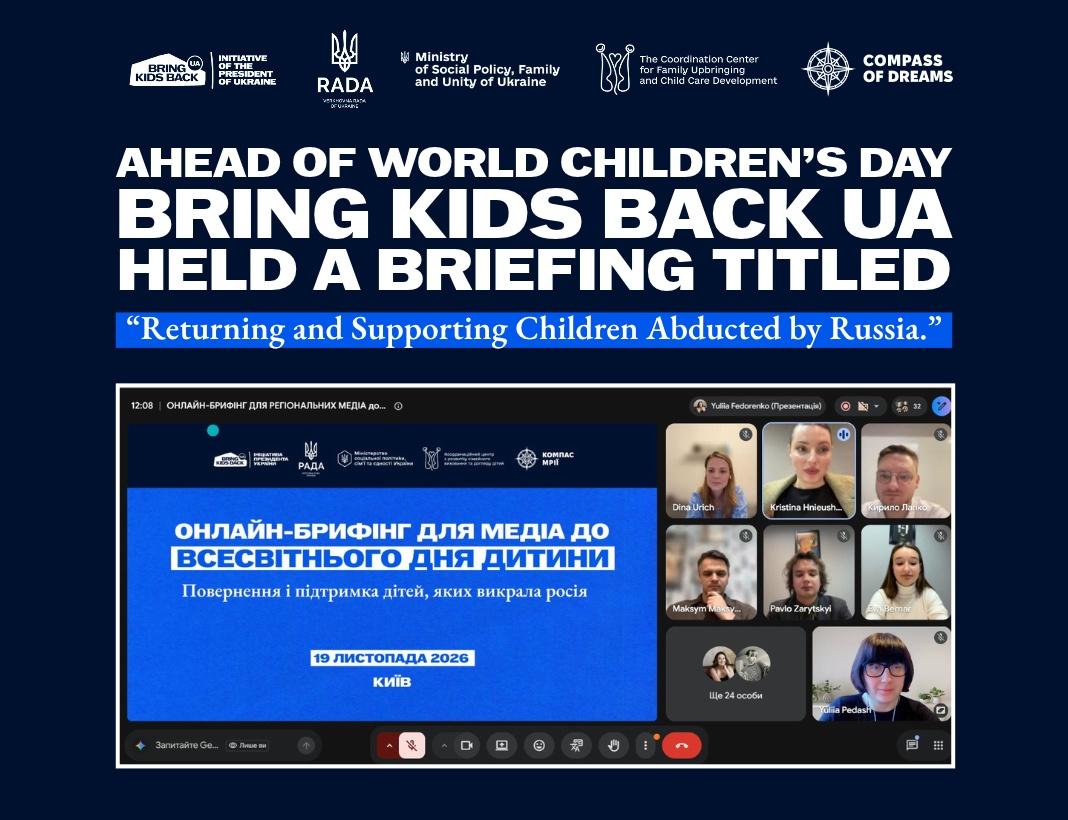
Ahead of World Children’s Day, Ukrainian President Volodymyr Zelenskyy’s Bring Kids Back UA initiative held an online media briefing on the return of Ukrainian children affected by deportation, forcible transfer and life under occupation. Protecting children’s rights requires concrete action: returning them to a safe environment, restoring family ties, supporting reintegration, ensuring access to education and providing assistance.
The media play an important role in the return of children. Media coverage helps secure support from international partners and enables young people living under occupation to learn that they can leave and that support awaits them in Ukraine.
The briefing brought together Maksym Maksymov, Head of the Bring Kids Back UA initiative; Yevheniia Kravchuk, Member of the Parliament of Ukraine; Liudmyla Shemelynets, First Deputy Minister of Social Policy, Family and Unity of Ukraine; Kyrylo Lapko, Head of Reintegration at the Coordination Centre for the Development of Family-Based Care and Childcare; and Dina Urikh, Head of the NGO Compass of Dreams. They shared the results of their work, key priorities and practical experience in the return and reintegration of children and young people.
“The media play a crucial role in bringing children home. Without public attention to this issue, it is much harder to encourage partners to support Ukraine’s efforts, including by strengthening sanctions against Russia. Russia blocks access to information, so every story published by Ukrainian and international media provides young people living under occupation and their families with truthful information: we are waiting for every child,” emphasised Maksym Maksymov, Head of Ukrainian President’s Bring Kids Back UA initiative.
“The new European Parliament resolution concerns not only deported children but every child in the occupied territories. That is 1.5–1.6 million children whose Ukrainian identity is effectively being erased. The Russians understand that killing 40 million Ukrainians is impossible. But erasing their identity — especially that of young children born under occupation — is another way of erasing an ethnic group. This points to genocidal intent. That is why sanctions are needed not only against those who organised the removal of children but also against those who finance militarised camps, including Gazprom and other major Russian companies,” said Yevheniia Kravchuk, Member of the Parliament of Ukraine.
“We must not only bring a child back but also help restore their everyday life, return them to education, provide the support they need and give them a sense of safety and home. Every child has a different experience: some were separated from their families, while others were subjected to propaganda and violence. That is why we are developing a service based on an individual approach to each family. This support must continue for as long as it takes to ensure a full recovery,” said Liudmyla Shemelynets, First Deputy Minister of Social Policy, Family and Unity of Ukraine.
“Reintegration begins in the first minutes after crossing the Ukrainian border. Our task is to understand the needs of each child or young person and provide the necessary support. Initially, this means safe accommodation, medical and psychological assistance, restoration of documents and financial support. The next steps include returning to education, catching up on learning losses, enrolling in educational institutions and finding long-term housing solutions. We develop an individual support plan for every child and coordinate the work of government agencies and partner organisations. It is important that this support continues in the community where the child or young person will build their future,” said Kyrylo Lapko, Head of Reintegration at the Coordination Centre for the Development of Family-Based Care and Childcare.
“Word of mouth remains the main channel of information. People decide to leave because someone who has already made the journey tells them that it is possible. Young people often say they watched an interview with someone who had left earlier — and that was what prompted them to start looking for ways to leave. This is why media work matters,” said Dina Urikh, Head of the NGO Compass of Dreams.
The briefing was not only about young people but also included their voices. Yeva, who left a temporarily occupied territory this year and enrolled at a Ukrainian university, shared her personal experience.
As of 19 November, a total of 2,833 children had been returned as part of the Bring Kids Back UA initiative.
The media play a particularly important role in efforts to bring children home. They know their audiences well and maintain connections with people who still live in temporarily occupied territories. Coverage of these issues keeps Ukrainian children’s fate in the public eye and on the agenda of international partners. It also provides children, young people and their families with verified information about where to seek help and what support, educational opportunities and other options are available after their return.